










































Association of a Public Health Campaign About Coronavirus Disease 2019 Promoted by News Media and a Social Influencer With Self-reported Personal Hygiene and Physical Distancing in the Netherlands
Amsterdam University Medical Center - VU University Medical Center (Yousuf, Van Rossum, Hofstra); Duke University (Corbin, Zhao, Jiang, Lindemans); Erasmus University (Sweep, Hofstra); VU University (Scherder); Erasmus MC (Van Gorp); UMCU (Zwetsloot); Icahn School of Medicine, Mount Sinai Hospital, St Luke's Hospital (Narula)
"In this survey study of hygiene awareness and behavior in the context of the coronavirus disease 2019 pandemic, exposure to a targeted campaign video and news article was associated with an approximately 2-fold increase in the odds of washing of all required hand areas and longer duration of handwashing."
It has previously been shown that, thanks to their extensive reach and engaging nature, entertainment media and social media have the potential to influence awareness and behaviour. In the COVID-19 pandemic, digital interconnectedness creates not only the risk of widespread dissemination of misinformation but also creates opportunities for large-scale public health interventions, in the absence (to date) of a vaccine or effective treatment. The survey study presented in this paper investigated the effectiveness of an evidence-based public health campaign strategy, distributed by national digital media and designed with behavioural insights, to improve self-reported personal hygiene and physical distancing in the Netherlands in the midst of the first wave of the COVID-19 crisis.
At the time of this research-based initiative, the Netherlands had almost reached the critical point for hospital admissions and intensive care capacity in the southern part of the country, as was also observed in certain parts of other countries, such as northern Italy. By using evidence-based health campaigning based on a diagnostic survey, the researchers aimed to bridge the intention-behaviour gap to influence a greater behavioural change with the goal of flattening the curve and minimising the strain on the healthcare system.
For national distribution of the study's survey, the researchers relied on the reach of Dutch social influencer Govert Sweep (one of the authors of this study, who has more than 500,000 YouTube and Instagram followers) and the national newspaper De Telegraaf, which has a national circulation in both print and digital platforms. Nationwide distribution of the diagnostic survey was done on March 17 2020; it was completed by 16,072 participants. Analysis of these outcomes showed COVID-19 preventive behaviours coughing and sneezing into the elbow were done well, but that handwashing, face touching, and physical distancing showed serious gaps compared with advised behaviour.
The results of the diagnostic survey were used to design a social media campaign, which was launched on March 21 2020. It was grounded in social norm theory. Social norms are what individuals believe is typical behavior (i.e., how people around them typically behave), as well as what they believe others perceive as appropriate behaviour (i.e., how one should behave). The researchers leveraged the power of social norms by having the influencer and the newspaper model appropriate behaviour to their audiences.
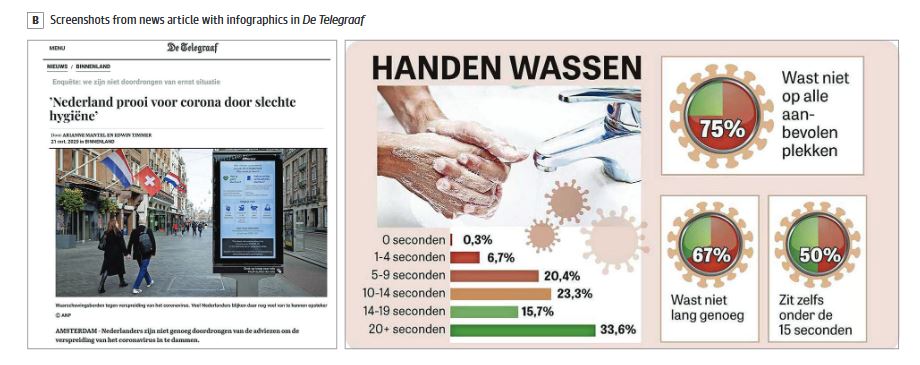
Specifically, De Telegraaf created a news article with infographics showing gaps in behaviour based on the results of the diagnostic survey (see above). It included a link to the evidence-based campaign video with Govert Sweep (see below), which featured thorough instructions on how to wash hands properly and an interview with a well-known virologist on the importance of physical distancing and avoiding face touching.
Among the 17,189 participants who completed the postcampaign survey on March 24 2020, 4,751 reported not having seen either the video or infographics (unexposed group), 263 participants reported having seen the video only (video-only group), 11,348 participants reported having seen the infographics only (infographics-only group), and 827 participants reported having seen both the video and infographics (video and infographics group). The online version of the infographics in De Telegraaf was read more than 2 million times, and the influencer video was watched more than 80,000 times. Cross-sectional analysis of the postcampaign survey using logistic regression correcting for age, gender, and educational level showed that:
- Exposure to the video plus infographics (827 participants) (adjusted odds ratio [OR], 2.14; 95% confidence interval (CI), 1.83-2.50; P<.001) and to the infographics alone (11,348 participants) (adjusted OR, 1.31; 95% CI, 1.22-1.40; P<.001) was positively associated with washing hands in all areas compared with the unexposed group.
- Exposure to the video plus infographics (adjusted OR, 1.86; 95% CI, 1.59-2.16; P<.001) and to the infographics alone (adjusted OR, 1.27; 95% CI, 1.19-1.36; P<.001) were positively associated with washing hands long enough compared with the unexposed group. Exposure to the video alone was not associated with improved handwashing.
- Compared with the unexposed group, exposure to the infographics alone and video plus infographics were associated with improvements in physical distancing when the participant had COVID-19 syptoms (infographics alone, adjusted OR, 1.10; 95% CI, 1.03-1.17; P=.006; video plus infographics, adjusted OR, 0.79; 95% CI, 0.69-0.91; P=.001) and face touching (infographics alone, adjusted OR, 1.29; 95% CI, 1.22-1.38; P<.001; infographics and video, adjusted OR, 1.49, 95% CI, 1.30-1.71; P<.001).
In short, exposure to the infographics only and to the infographics plus the video were associated with a larger proportion of participants washing hands long enough and in all areas. Participants exposed to the video alone did not show these improvements, which may be associated with the small sample size of this particular group. Exposure to the infographics plus the video showed significant but small improvements in awareness on face touching and physical distancing. The unexposed group of the postcampaign survey reported better results on personal hygiene compared with the participants in the diagnostic survey; this indicates that public health messages by the government already showed substantial benefit.
Per the researchers, "To our knowledge, the strategy of first diagnosing the biggest gaps in behavior and awareness and designing the campaign at this scale in such a compressed time frame has not been shown before. We believe that the strategy to use a large-scale, science-based public health intervention can be easily replicated in other countries. A similar strategy could also be of potential use to help with other pressing issues during the crisis....Furthermore, evidence-based public health campaigning may have the potential to combat chronic pandemics, such as obesity, lack of exercise, and smoking."
In conclusion: "[N]ational public health campaigns using new-media platforms and social influencers should be considered in addition to contact tracing, testing, and lockdown measures as initiated by governments."
JAMA Network Open. http://jamanetwork.com/article.aspx?doi=10.1001/jamanetworkopen.2020.14…
- Log in to post comments