










































AIDS and Disability Campaign
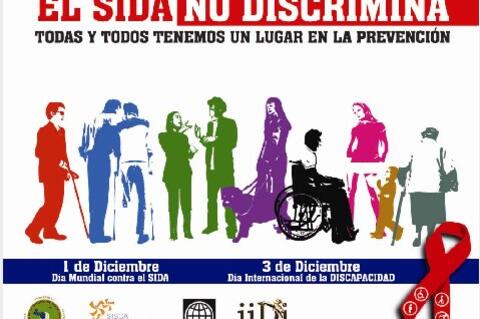
The colourful poster, in Spanish, says at the top: "AIDS does not discriminate. All of us have a role in its prevention." At the centre, there is a "red" figure of a blind man with a cane, two "blue" men together - one being an amputee, a "green" couple communicating using sign language, a "purple" woman with a seeing eye ("guide") dog, a "black" figure of a man in a wheelchair looking at a "pink" teenaged girl, a "brown" boy (possibly with Down syndrome), and a "grey" elderly woman with a cane. At the bottom is blue text saying: December 1, World HIV/AIDS Day and December 3 - International Disability Day. There is also a red ribbon with the disability symbols for motor, hearing, visual, and intellectual/mental disabilities.
HIV/AIDS, Disability, Rights.
Evidence such as this Global Survey on Disability and AIDS conducted by Yale University and the World Bank indicates that people living with disability have the same or higher level of exposure to all known risk factors for HIV infection. For example, adolescents and adults with disabilities have equal probability as their peers without disabilities to be sexually active. Homosexuality and bisexuality seem to occur in the same proportion among people with disability and those without - as does drug and alcohol use (according to the United Nations Children's Fund (UNICEF), 1999). In fact, as IIDI points out, it is even more likely that men and women with disabilities are victims of violence or of rape, yet at the same time they are less likely to succeed in obtaining police intervention, legal protection, or prophylactic care.
IIDI points out that reaching people with disabilities with messages related to HIV and AIDS, health care, and reproductive health services presents unique challenges. In some cases, for example, low literacy rates and limited levels of education complicate the understanding of these messages. Furthermore, messages and communication about HIV are often inaccessible to people who are blind or deaf, and facilities for medical services are often not accessible to people with physical disabilities. Finally, persons with disabilities in many countries report being rejected from testing centres or HIV or AIDS clinics, where a clinical staff may assume, falsely, that people with disabilities are not infected with AIDS.
IIDI (formerly: Inter-American Institute on Disability-IID) was founded in Washington, DC, United States (US) in January 1999 to promote the inclusion and the autonomy of people with disabilities and their families, in the Inter-American Region. In addition to its headquarters in New York City, US, IIDI has two regional offices: San José, Costa Rica (for Latin America) and Rio de Janeiro, Brazil (for the South Cone). IIDI works through two main strategic axes: human rights and inclusive development.
The Disability Office in El Salvador, The World Bank, SISCA, the IIDI, the National HIV/AIDS Program, and disability NGOs.
Emails from Rosangela Berman Bieler to The Communication Initiative on November 18 2009 and February 12 2010; and IIDI website, December 10 2009.
Comments

ASSISTANCE FOR DISABILITY WHO IS AVICTIM
Most people with disability are prone to getting infection since they are discriminated so you as an organisation which suport do you offer to such people
aids and disability campaign
the poster summarizes it all - how can one get it?
- Log in to post comments