










































Agriculture technology meets Old MacDonald’s
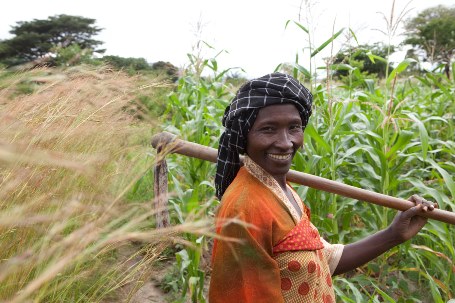
Author Fidelis Zvomuya, December 12 2013: Ayanda Mhlaba lives in Sekhukhune in the Limpopo province of South Africa. Mahlaba is a 56-year-old farmer and a mother of three children. She had gone through a customary marriage, had a lobola [dowry] ceremony, and later her marriage was registered through a legal office.
"My marriage helps my community and family to acknowledge what wealth I brought to my family. Many of my friends had gone through a polygamous marriage. The traditional leaders, 'to be' husband and elders made these decisions for them."
In Sekhukhune, some of Mhlaba's friends travel to Johannesburg, some 400km to buy clothes and other items to sell in the village to generate income for the family members. Other friends make a living by selling eggs, African beaded (or printed) mobile phone pouches, pen cases and vegetables.
Mahlaba used to sell vegetables before she decided to farm and at that time was earning as little as US$3 a day. She is currently a livestock farmer and had a chance to be introduced to the use of Information and communications technology (ICT).
"I can confess, I was definitely the proverbial Old MacDonald's after my husband had said no to the implementation of technology at the farm. I couldn't believe that one day I will use cell phone and internet technologies as tools that will improve my production, cut my overhead costs and improve my profits," she said.
After attending some farming technology conferences, seminars and workshops for several years, slowly Mhlaba started believing in the marriage between IT and farming activities and, like all wives, managed to convince her husband one day during a pillow talk.
These forums exposed her to computers and while, attending some, Mhlaba used to make side trips to visit well established white commercial farmers who were transforming their traditional farms into far larger commercial operations through the use of technologies.
Due to IT, Mhlaba now knows what was grown in each field in the past and how much it yielded under different growing conditions. IT would also know about crucial characteristics of the field like irrigation, drainage, soil and monitors all the movements of her cattle.
She is currently one of the smallholder farmers using ICTs at her farm and also mentioned that it would have been ideal for these rural women to market products or generate income through ICTs skills as well.
Mahlaba uses ICTs such as mobile phone, computer, internet (email), fax, newspaper, TV and radio. Radio was mostly used for listening to music or news. She also uses ICTs to communicate, to exchange information, for security reasons and to learn new ICT skills especially through the use of computer as well as the internet.
"I was now reading farming news online from all newspapers" and this increased her vocabulary as well as enhance her knowledge. "The internet, email and newspaper helped to understand what is going on around me,” she said.
Mostly, rural women lack skills to use technology, have to meet cultural expectations, and they have to hold on to their traditions. They also work within the rural household that involves productive work outside, such as providing basic needs to other family members, for example, food, water and fuel.
The high rate of death in Africa due to malnutrition and diseases and the impact of HIV/AIDS should be examined with other factors such as food insecurity, high climate variability, market fluctuations, and poor governance.
According to Dr. Agnes Matilda Kalibata, Rwanda’s Minister of Agriculture and Animal Resources, through ICTs, rural women can be used as agents of development. In an interview during the ICT4Ag conference held in Kigali, Dr. Kalibata said women farmers' development is a complex process which needs participation in developmental activities that shape their lives.
"They are keepers of agricultural and health-related knowledge. ICTs can enable the participation of women in the developmental projects to alleviate poverty, provide them with education and training as well as other informal employment opportunities," she said.
Jennifer Britton, Deputy Programme Director at the Caribbean Community, said ICTs are enablers of rural women’s development and an instrument for bridging the gap between the rich and the poor.
"ICTs can provide rural women, access to information about agricultural market and health information. ICTs can also ensure participation in political changes. A women friendly approach to development, pro-poor growth policies and inclusion of gender issues in ICT policies, plans as well as strategies. This will provide more opportunities for African rural women" she said.
Click here to read this blog on Africa Green Media.
[Editor's note: Journalist Fidelis Zvomuya attended the International Conference on ICT4ag, which was co-hosted by the Technical Centre for Agricultural and Rural Cooperation (CTA) and the Rwandan Ministry of Agriculture and Animal Resources (MINAGRI), November 4-8 2013, Kigali, Rwanda.]
- Log in to post comments