










































Aflatoun (Child Savings International)
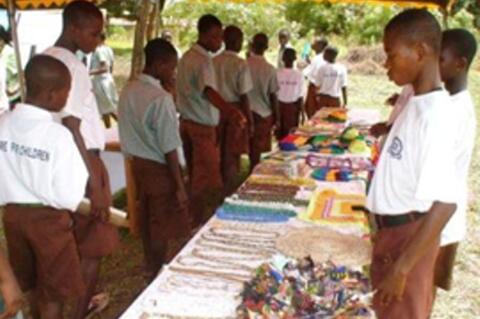
By teaching basic social and financial skills, and providing children with practical experience, Aflatoun seeks to harness the early period in a child’s life for exploration, learning, and character development through a social and financial education programme. Its five core elements are:
- Personal Understanding and Exploration
- Rights and Responsibilities
- Savings and Spending
- Planning and Budgeting
- Social and Financial Enterprise
Aflatoun is a network of partner organisations with a shared mission. The "core objective and key goal is to become the social and financial education programme of choice globally." The work of scaling the programme for international partnership has meant developing the following:
- "Balanced child social and financial education curricula
- High quality programme with a recognisable brand
- Global network with a mixed group of partners
- Scalable for greater reach in countries wherever the programme is delivered
- Cost effective using economies of scale, both locally and at the secretariat level
- Easily implementable with low technical barriers to entry
- UN [United Nations] Convention on the Rights of the Child based and in support of the Millennium Development Goals"
Click here to access the Aflatoun programme. As stated on the website: "Aflatoun’s curriculum contains both social and financial themes. Children learn about themselves, children’s rights, how to save, basic financial concepts, and enterprise.
The teaching principle used in Aflatoun’s programme is called child-centred learning. Children are given space to express themselves, to act on their own, and to solve practical problems together.
They act in these situations according to the Aflatoun motto 'Explore, Think, Investigate and Act'. Methods of learning include story telling, song, drama and dance, games, savings clubs, financial enterprises and community improvement activities.
The curriculum itself was refined over 17 years of action research in India, followed by 10 pilot projects around the world. It has been adapted to be appropriate for children in different regions and of different ages, and to be taught both in classrooms and out of school. Aflatoun partners have translated the curriculum into over 30 languages and have contextualized it for over 60 countries."
There are three types of materials available:
- The Formal Primary Curriculum: Workbooks for children from ages six to fourteen.
- The Non-Formal Education: A single resource manual for facilitators to use with children in need of special protection and children in non-formal settings.
- Aflateen: A curriculum for older teenagers/young adults, piloted in 2011, designed for educators, facilitators, or youth peer-to-peer mentors.
Education, Children, Rights
Aflatoun started in Mumbai, India, in 1991, as an action research project by academics from the Tata School of Social Studies. In 1993, the programme responded to inter-ethnic riots by focusing on combating prejudice and discrimination through rights education. Expansion out of the city and into rural areas led to harnessing the energy and creativity of entrepreneurial children at home to keep them from seeking street work in cities. This included developing savings groups, a defining programme feature since 2001.
In 2005, Aflatoun incorporated in Amsterdam, the Netherlands. To test whether the programme would work outside India, organisations in ten countries launched the programme. Once the Aflatoun programme model was developed, a “Campaign for Social and Financial Education” was launched in March 2008 by Princess Maxima of the Netherlands. The campaign’s goals were to reach one million children in 75 countries within three years.
In 2011, Aflatoun broadened its curriculum offering by providing a programme for youth called Aflateen, tailored specifically for youth. Looking at themes such as identity and finance, young people develop financial knowledge by incorporating practical activities, including savings clubs, enterprise creation, and community activities.
Having reached its campaign goal of one million children, Aflatoun announced that its new strategic goal would be: 10 million children reached by 2015.
The Amsterdam Institute for International Development (AIID) website, August 22 2012.
- Log in to post comments