










































Rapid Gender Analysis - COVID-19
CARE
"Women are excluded from information sharing on COVID-19 and from key high level decision making processes at national and regional level....Despite this, the analysis reveals how coronavirus is also creating opportunities to disrupt deeply entrenched gender inequalities."
The COVID-19 crisis and the application of the preventive measures taken in West Africa, including movement restriction measures (confinement, curfew, border closures), social distancing, and the closure of schools, have had an impact on all aspects of people's lives. CARE's COVID-19 pandemic response strategy in West Africa, most of whose countries were already fragile, has emphasised gender-focused and feminist approaches. To that end, the organisation carried out a Rapid Gender Analysis (RGA) with the objective of highlighting and understanding the gendered impacts of the COVID-19 crisis and formulating practical recommendations for direct response and advocacy.
For the RGA, CARE interviewed 266 people (52% women and 48% men) representing communities, technical and health ministries, United Nations (UN) agencies, and international non-governmental organisations (NGOs) and women's rights organisations across 12 countries in West Africa. Using a do-no-harm approach, with a focus on mitigating the risk to CARE staff and communities, data collection (April 6-23 2020) was done remotely by phone, using instant messaging services, or, when appropriate, face to face using distancing measures.
Key findings, with an emphasis on communication-related findings:
- With widespread government lockdowns, humanitarian actors are having increased difficulty reaching those in need. World Bank projections around the COVID-19 pandemic's impacts forecast a reduction to the already-low human development score. According to the Economic Community of West African States (ECOWAS), the impact of the COVID-19 pandemic could increase the number of people at risk of food insecurity and malnutrition from 17 million to 50 million people between June and August 2020. Women are particularly at high risk in this context.
- Women are suffering from more gender-based violence (GBV) due to general social stress combined with the increasing tensions surrounding having the family sequestered at home, on top of limited access to food and basic supplies. The informal social safety nets and networks many women previously relied on for support are weakened due to reduced physical mobility and social distancing.
- There is an overarching fear of contracting the disease and social distrust, especially towards foreigners, people coming from big cities, and those with elderly family members. Respondents repeatedly mentioned a sense of anxiety, in particular by youth, who are out of school and unable to access their routine activities. Meanwhile, very few mental health services exist that can offset the need for support.
- Women confirm that governments and health clinics have diverted energy and attention away from sexual reproductive and health and rights (SRHR) services. Between social distancing slowing down service provision and fear of attending clinics, it is very hard for women to access SRHR services. A decreasing number of youth accessing health services was also noted.
- Misinformation is easier to access than official information. People are relying heavily on traditional healers, and rumours are spreading faster than official government information. At the same time, women and youth have little access to traditional information channels like TV and radio because men control these outlets in the household. In addition, broadcasts sharing information usually air at times when women are doing domestic labour. Women reported WhatsApp to be the most preferred source of information, as it is accessible for illiterate populations. Relying on social media carries risks, however, as these media are a common source of false information.
- In general, the respondents have a good knowledge of preventive measures, but they are not likely to apply many of them. Hand washing is the most commonly practiced preventative measure, because handwashing stands are available in public places, and previous experience with Ebola and Islamic ritual washing makes handwashing a common habit. However, precarious living conditions and high population density in working-class neighbourhoods (especially in urban areas) make it difficult to practice social distancing.
- Overall, the participation of women in community decisions is not systemic and remains subject to their availability, as described by a respondent from Ghana: "Women participate in decision-making forums if that does not coincide with the moments of their domestic tasks."
However, the RGA identified several opportunities that can be seized - in the immediate and long terms - in the context of the pandemic to effect lasting changes:
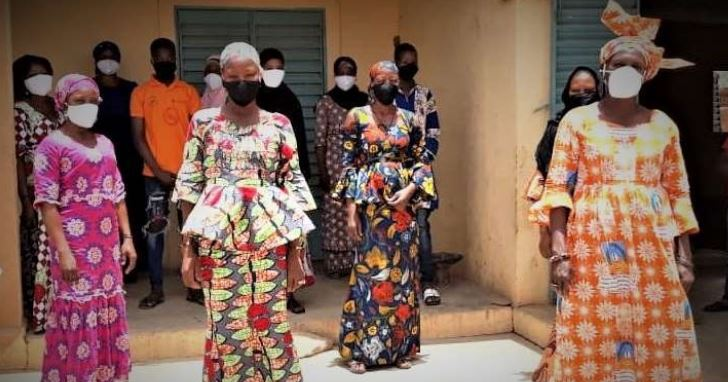
- Availability and adaptability of actors at community level ready to support prevention activities: Community leaders and women members of Village Savings and Loans Association (VSLA) groups are already raising awareness of the preventive measures of the disease. Members are changing their group methodology to allow for social distancing and to support hygiene while maintaining solidarity and safety nets. Even beyond COVID-19: "We could relay messages shared during meetings to reach women who do not have television, radio, telephone, and social media and who do not understand French," said a woman leader member of a VSLA.
- Development of digital operating capacity: This pandemic has demonstrated that it is possible to work remotely if given the appropriate capacities, which could serve as a trigger for humanitarian actors to develop the capacities required to continue interventions remotely in the future if and when necessary.
- The transformation of gender roles and relationships within households: The long period of confinement has brought families together: "Men no longer go to the bars to drink," said a respondent from Ivory Coast. On the contrary, they are involved in domestic tasks, which undoubtedly enables them to understand the implicit struggles. Men may be be more willing to continue their domestic work even after the confinement and the pandemic.
- Opportunity to develop local or women-led innovation and technology at local level: Instances such as the design and construction of washing stands with local or recycled materials and the creative use of social media during the pandemic have shown that "with a little imagination and support", men, women, and young adolescents "can develop innovative and attractive initiatives that could strengthen their socio-economic empowerment while reducing their vulnerability to the risks of GBV."
Selected recommendations:
Ensuring a community-led response
- Engage women, youth (both boys and girls), traditional leaders, and religious leaders in analysis, problem solving, and decision making to address this complex socio-cultural and economic issue.
- Involve all stakeholders in the design and development and identification of outlets for COVID-19 prevention messages and communication to reach vulnerable populations. This should include messaging around engaging men and boys in shared household tasks, sharing decision-making power between men and women, participation of women, GBV and positive masculinities, rumours and false information about COVID-19, and more.
- Do not ignore or isolate youth. Instead, listen to their concerns and ideas, and include them in seeking solutions and innovations for adaptation and prevention. Invest in out-of-school, COVID-19 safe activities for youth so they can actively contribute to the community response and engage in social development.
- Ensure women have access to accurate information via VSLA groups and their social networks to then share amongst their WhatsApp groups and other networks.
Strengthening food and nutrition security - e.g., ensure households understand the importance of nutrition through community awareness campaigns so everyone can base their family meals on accurate information.
Supporting early recovery initiatives and strengthening economic activities for women and members of VSLA groups - e.g., support these groups in the use of smart phones / tablets and social media to initiate online sales locally.
Addressing GBV
- Ensure that adequate and appropriate prevention and response measures are put in place for GBV among essential services, such as information for support (e.g., hotlines).
- Support the implementation of safe spaces for women that are specifically adapted to the COVID-19 context, which could include VSLA-led virtual safe spaces.
- Encourage innovations for VSLA members to maintain strong social safety nets and member solidarity to provide support and protection.
- Support initiatives to discourage child marriage, which has increased as a coping mechanism during the pandemic.
Strengthening access to services and basic health care
- Ensure basic health services for issues other than COVID-19 are available, including through remote clinics and increased home visits by trained community health workers.
- Equip health centres with information and communication systems on the disease for health service seekers and visitors.
- Ensure accurate health centre outreach to communities with accurate information, as many women and children are afraid of accessing formal health services.
- Ensure messages are designed and use the appropriate channels to reach adolescent boys and girls and women.
Seizing the opportunity to reduce the digital divide
- Engage youth (boys and girls) to identify the best digital platforms for information sharing, reinforcement of social safety nets, and sharing of accurate information.
- Promote women's engagement with digital spaces through support to VSLAs for the identification and inclusion of remote operation measures in the VSLA module and operating rules.
- Connect women and youth with media agencies and mobile phone companies for the production of jingles on the above themes and their dissemination as default ringtones, etc.
- Connect women and youth with impact/innovation hubs for solutions so as to reduce the spread of COVID-19.
- Ensure marginalised communities, especially women and youth, can be heard through the establishment of mechanisms of accountability and monitoring, as well as through the management of complaints and abuses via cellphone communication platforms.
- Resource and train communities so as to to establish remote monitoring of humanitarian programmes through mobile applications.
ReliefWeb, May 20 2020 - accessed on June 17 2020. Image credit: VSLA/MJT Mali – Social distancing while maintaining solidarity and the social safety net - CARE Mali
- Log in to post comments